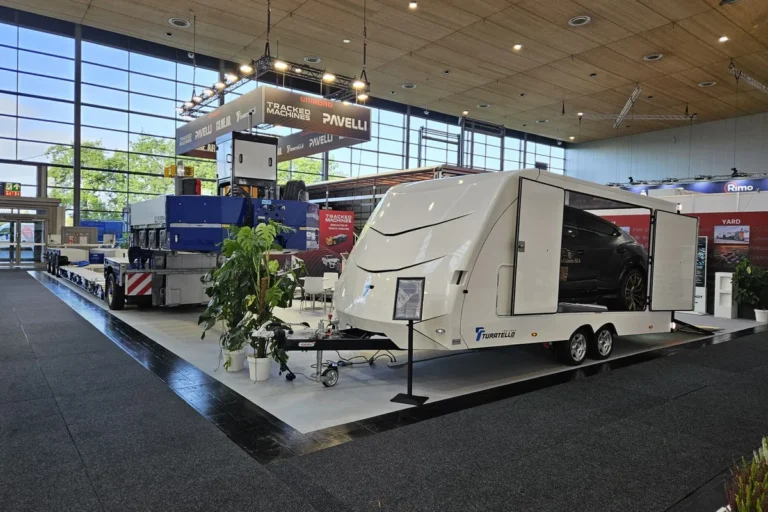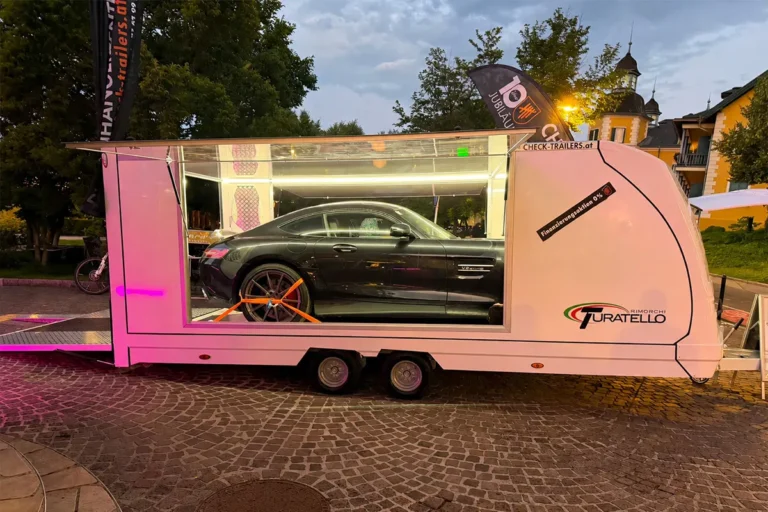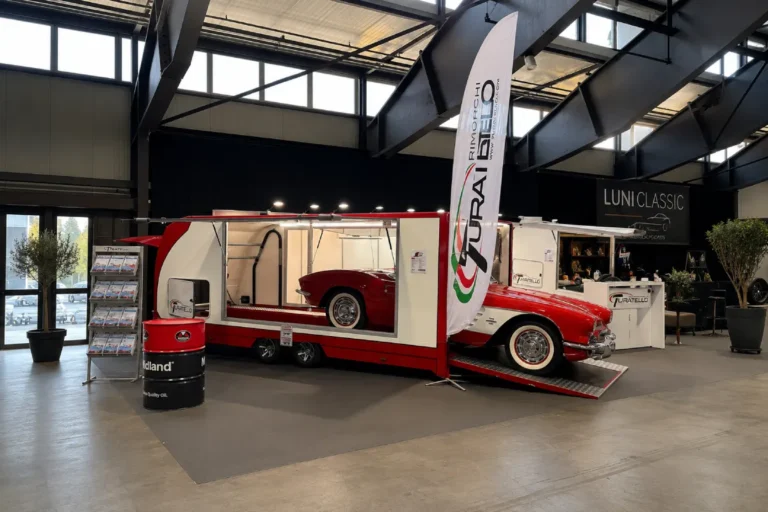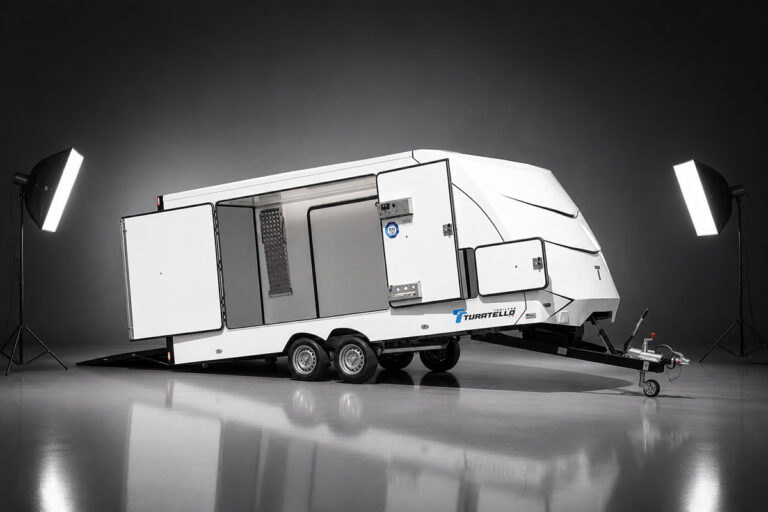
When you look at a finished trailer, it’s easy to focus on the design, size, or features. But there’s much more to every high-quality trailer: design, material selection, manufacturing, technology, assembly, and quality control.
In fact, every detail contributes to defining fundamental characteristics such as sturdiness, reliability, functionality, and durability.
But how is a trailer actually made?
Let’s take a look at Turatello Trailers ’ manufacturing process to find out what happens before a trailer is ready to hit the road.
#01
It all starts with the design
Before there is steel, welding, and assembly, there is a design.
Design is one of the most important stages because a trailer must not simply transport a load—it must do so while ensuring functionality, stability, and ease of use, taking into account its specific intended use.
Transporting a sports car, a classic car, a race car, or cargo involves dealing with very different requirements.
For this reason, the trailer’s chassis and configuration must be designed with numerous factors in mind: dimensions, load capacity, weight distribution, accessibility, loading angle, and intended use.
Good design, therefore, stems from a very simple question: What will this trailer actually be used for in real life?
#02
The frame: the structure on which everything is built
If the design represents the idea, the frame is its supporting structure.
It is one of the key components of a trailer and must be designed to ensure the right balance between strength and weight.
Turatello manufactures its frames using tubular galvanized steel that is welded and painted, with structures designed according to the trailer’s intended use.
The build quality of the chassis directly affects the performance of the entire vehicle and its ability to withstand the stresses caused by transportation and road conditions over time.
It is not, therefore, simply a matter of building a sturdy structure, but of finding the right balance between strength, geometry, and overall weight.
#03
Materials Make All the Difference
In the transportation sector, weight is a key factor.
Reducing the weight of the structure without compromising its strength and reliability allows for better utilization of the available load-carrying capacity.
That is why the choice of materials plays a central role.
In the construction of its van bodies, Turatello also uses fiberglass-reinforced plastic insulated sandwich panels, combined with anodized aluminum profiles.
This solution combines lightness, durability, and protection, creating a sealed environment designed to shield the contents from external elements.
The search for the most suitable material is therefore not just about aesthetics: it is an integral part of the trailer’s performance.
#04
Functionality means designing with the user in mind
A trailer may be technologically advanced, but above all, it must be practical to use.
This is where the details come into play—details that can make a big difference in everyday use.
Ramps, tailgates, side doors, storage compartments, tilting systems, access points, and spaces designated for equipment and spare parts must be positioned and sized with the user’s operations in mind.
When transporting sports cars and race cars, for example,the approach angle also becomes a critical factor: vehicles with particularly low ride heights require a design that makes loading them easier.
The quality of a trailer, therefore, is not measured solely by the materials used, but also by its ability to make operations easier for those who use it.
#05
Customization as Part of the Project
Not everyone drives the same vehicle. Not everyone takes the same path. And above all, not everyone uses the trailer in the same way.
For this reason, the ability to customize a configuration can be an important factor even during the design phase.
The dimensions of the van body, including height, doors, tailgates, ramps, interior space, and accessories, can be customized to meet specific needs.
It is an approach that transforms the trailer from a simple means of transportation into a tool for work or a hobby, designed with the user in mind.
For those who race on the track, for example, the interior space can be organized to accommodate spare parts and equipment. For those transporting a classic or collector’s car, however, protection, ease of access, and interior care may take priority.
#06
Assembly and Attention to Detail
Once the various components have been completed, the project finally takes shape.
Assembly requires precision because each component must fit together properly with the others: chassis, axles, floor, body, doors, ramps, and equipment.
It is at this stage that even the details take on particular importance.
Alignment, finishes, fasteners, movement, and the integration of the various components all contribute to the perceived quality, but above all to the product’s functionality over time.
#07
Before hitting the road, check these things
Construction isn’t over when the last component is installed.
Before a trailer can be delivered, it is necessary to verify that the various systems are functioning properly and that the product meets the specifications set forth in the design.
Final inspections are therefore the last step in a process that began much earlier, with a technical design.
This is the moment when the design, materials, manufacturing processes, and assembly must prove that they function as a single system.
Much more than just a means of transportation
Behind every trailer lies a range of skills that often isn’t immediately apparent.
Design, experience, knowledge of materials, and attention to the needs of the product’s users are what make it possible to transform a structure on wheels into a reliable and functional transportation solution.
This philosophy guides Turatello Trailers from the design phase through to the manufacturing of its trailers: starting with real-world needs to develop solutions that combine build quality, technology, functionality, and design.
Because a trailer isn’t just supposed to reach its destination.
It must protect and support what matters, kilometer after kilometer.
Do you have a specific transportation need?
Every project starts with what you need to transport and how you want to do it.